Conceptual visualization · not experimental data
THE CAUSAL DATA ENGINE UNDERPINNING AI DRUG DISCOVERY

CellCodex. AI is ready for biology.Biology isn’t ready for AI.

CellCodex combines human cell engineering, experimental perturbation and AI modelling to investigate disease biology. Its Max-Diff approach aims to connect biological changes with their causes.

From cells to causesConceptual visualization · not experimental data
01ENGINEER02PERTURB03READ04LEARN
01 / THE BIOLOGICAL BOTTLENECK

Better models begin with better biology.

Correlative snapshots describe what changes, but do not necessarily explain why. CellCodex’s approach brings disease-relevant human cell states and designed perturbations into the experimental loop.

Why causal data?
01

The right cellular context

Model the biological question in relevant human cell states.

02

Designed perturbations

Investigate responses to genetic and compound changes.

03

Multimodal measurements

Connect single-cell measurements with imaging.

02 / THE MAX-DIFF PLATFORM

A closed-loop engine for biological intelligence.

Max-Diff is a company-described research and data platform. Human cell engineering, perturbation, measurement and modelling inform one another in a continuous experimental loop.

01 / ENGINEER

The right cells, in the relevant state.

Programme human stem cells into target cell types and develop aged, disease-relevant states.

Research architecture, not clinical validation.

Reference & provenance

Cell purity, maturity benchmarks and reproducibility datasets are not published in the reviewed material.

Explore the engine
Experimental and model feedbackResearch architecture, not clinical validation.
The complete experimental loop

Engineer

Programme human stem cells into target cell types and develop aged, disease-relevant states.

Cell purity, maturity benchmarks and reproducibility datasets are not published in the reviewed material.

Perturb

Investigate genetic and compound perturbations at genome scale, including mature neuronal models.

Library coverage, experimental capacity and complete screening data are not specified.

Read

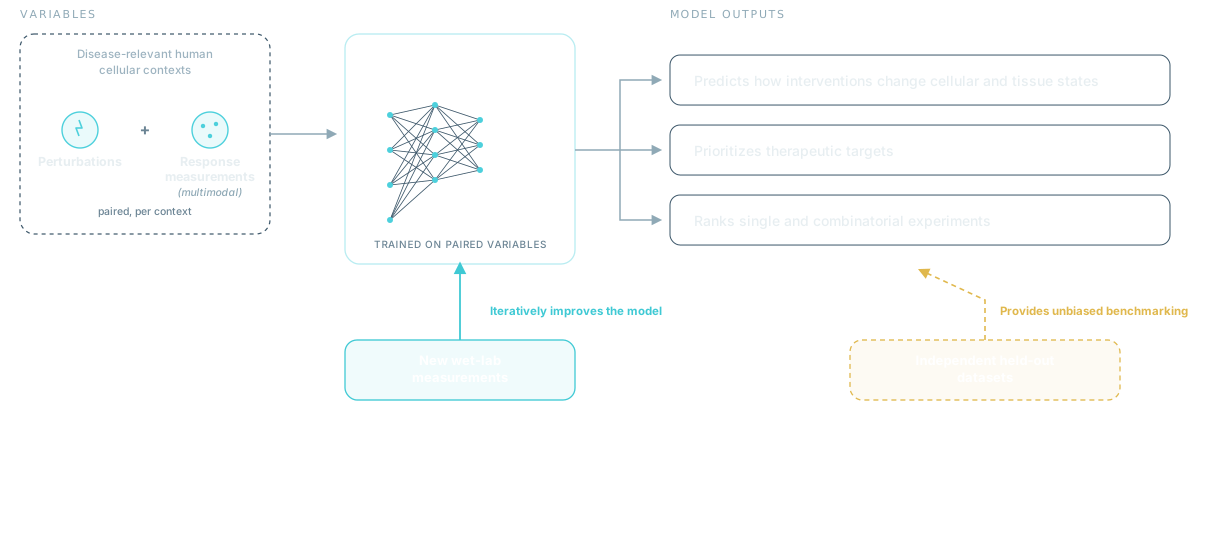
Single-cell multi-omics and live/high-content imaging produce multimodal measurements.

Commercial deliverable specifications, data size and quality-control thresholds are not established.

Learn

AI models use measurements to predict perturbation response and inform subsequent experiments.

Predictive accuracy, prospective validation and software access are not established.

The company schematic connects new wet-lab measurements to model development and separates independent held-out datasets for checking predictions. This architecture is not a published predictive-performance result.

03 / ONE ENGINE · TWO RESEARCH CONTEXTS

Different questions. Shared biology.

The published programme examples explore neurodegeneration and liver toxicity. Neither is presented here as an approved therapy or a clinically validated product.

01 /
NEURODEGENERATION

Parkinson’s disease

CellCodex reports genome-wide screens in human dopamine neurons that indicated a novel pathway now being investigated.

Reference & provenance

CellCodex reports genome-wide screens in human dopamine neurons that indicated a novel pathway now being investigated. The reviewed material does not identify the pathway or establish a named clinical candidate, clinical phase or patient efficacy.

SOURCE-REPORTED STATUS
Discovery research
Explore the research
02 /
LIVER TOXICITY MODELLING

HepatoTox Oracle

A research programme investigating human hepatocyte models to study and predict drug-induced liver injury. The company describes it as Innovate UK-backed.

Reference & provenance

A research programme investigating human hepatocyte models to study and predict drug-induced liver injury. The company describes it as Innovate UK-backed; the reviewed sources do not establish an award identifier, amount, clinical predictive benchmark or regulatory qualification.

SOURCE-REPORTED STATUS
Research platform / model development
Explore the research
04 / THE PEOPLE BEHIND THE QUESTIONS

Biology meets computational thinking.

Meet our people
Manos Metzakopian

Manos MetzakopianPhD

Co-Founder & CEO
Biography

The company reports a former CSO role at bit.bio, group leadership at the UK Dementia Research Institute Cambridge and work on genome-wide CRISPR screens in neurons.

Grant Belgard

Grant BelgardDPhil

Co-Founder & CTO
Biography

The company identifies him as founder of The Bioinformatics CRO and former VP Bioinformatics at bit.bio, with machine-learning and single-cell genomics experience.

Ravi Moorthy

Ravi Moorthy

Co-Founder & CCO
Biography

The company reports previous communications leadership at Scorpion Therapeutics and business-development and scaling experience. This previous-employer history is not a CellCodex acquisition claim.

Tom Weaver

Tom WeaverPhD

Co-Founder & Chairman
Biography

The company describes a life-sciences entrepreneurial background across academia, biotechnology and pharma.

Reference & provenance

Biographies and roles are company-attributed in the verified extraction.