From correlation to causal investigation.

Designed perturbations can support causal investigation. That does not automatically establish that every model output is causal or translates to patients.

THE BIOLOGICAL BOTTLENECK

Better models begin with better biology.

Correlative snapshots describe what changes, but do not necessarily explain why. CellCodex’s approach brings disease-relevant human cell states and designed perturbations into the experimental loop.

Original company schematic

Model scaling context

Model scaling context
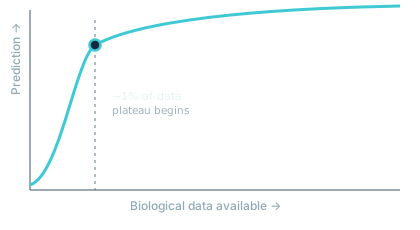
Original contextual saturation schematic, attributed by the company to DenAdel et al., Nature Methods (2026). The ~1% label is a schematic interpretation of external literature, not CellCodex data and not a universal estimate of biological-data value.

Model scaling context

Model scaling context

Original contextual saturation schematic, attributed by the company to DenAdel et al., Nature Methods (2026). The ~1% label is a schematic interpretation of external literature, not CellCodex data and not a universal estimate of biological-data value.

Original company schematic

Cell-state engineering

Cell-state engineering
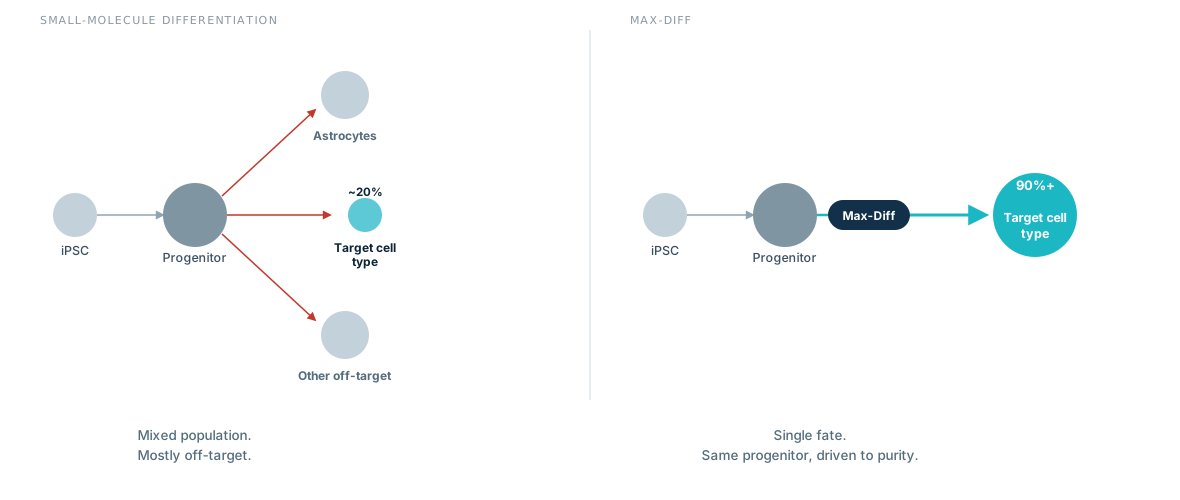
Original Max-Diff schematic. The ~20% and 90%+ labels are company-authored schematic claims, not independently verified purity benchmarks. The extraction does not include reproducibility datasets; preserve this qualification when interpreting the image.

Cell-state engineering

Cell-state engineering

Original Max-Diff schematic. The ~20% and 90%+ labels are company-authored schematic claims, not independently verified purity benchmarks. The extraction does not include reproducibility datasets; preserve this qualification when interpreting the image.

Original company schematic

Experimental and model feedback

Experimental and model feedback
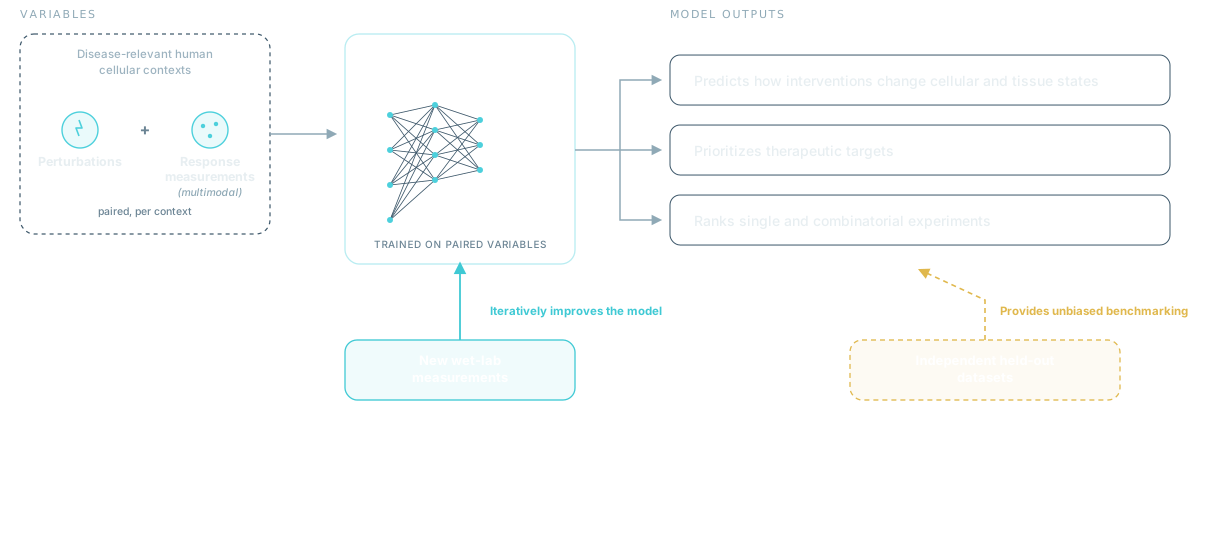
Original closed-loop schematic. Model outputs and held-out benchmarking are architecture objectives, not verified predictive accuracy, therapeutic efficacy or clinical performance.

Experimental and model feedback

Experimental and model feedback

Original closed-loop schematic. Model outputs and held-out benchmarking are architecture objectives, not verified predictive accuracy, therapeutic efficacy or clinical performance.

Reference & provenance

Evaluating the role of pretraining dataset size and diversity on single-cell foundation model performance. Nature Methods, published 9 June 2026. DOI: 10.1038/s41592-026-03120-y. This external research is context, not validation of Max-Diff or HepatoTox Oracle.

Read the reference

Evidence boundaries

Reference & provenance

The package includes company schematics and a verified external reference, but no full paper, corporate video, facility photographs or published prospective-validation dataset. No clinical benefit or regulatory acceptance is established by these materials.

Enabling technologies

The company narrative connects advances across the field. These are enabling technologies, not inventions or milestones attributed to CellCodex.

01 / iPSC reprogramming02 / Single-cell sequencing03 / Genome editing04 / Scalable cell programming05 / AI modelling
Reference & provenance

Verified extraction reviewed 13 October 2026